Welcome to Eden Sanctuary. A beautiful research and retreat center being developed in middle of the jungles of East Maui, over-looking the Pacific Ocean. There is no place on Earth like this one, and it wasn't easy to get it this far. Here's just part of the story...

5 Steps in the Making of Eden Sanctuary


Step 1 - Acquiring a slice of paradise

Just shy of 128 acres this pristine jungle property is on the east side of Haleakula outside the little town of Hana. Nestled in front of 3 mountain pua's in an area known as Kae'aleku or "the dark place." Construction began in February 2001 in earnest to develop a self-sustaining community and research center. The purpose of the research center and the people working and living there would be to create futuristic technology in the area of food creation and energy that could be modeled and transferred to other self-sustaining communities around the globe.

When the property was first acquired it was raw jungle land mixed with a few grassy pastures. Five river-streams flow through the property, in deep ravines and via underground lava tubes. It was called Eden Sanctuary because it was a unique place where living things abound, and where it feels like the world is new again. A sanctuary of protection for its inhabitants who live in harmony and balance with nature preserving its natural gifts

.

Step 2 - Cutting a road

Reality hit hard a few weeks into the project. We needed a road. A way to get people and materials up to the building sites. Sounded simple enough. Hire the local dozer guy to cut a path and then use our four-wheel drive trucks to haul materials up to the top. Reality was much more difficult and expensive.

Hana is wet place. Really wet. It's one of the primary benefits of an intensive agricultural research project. The land can grow most anything. Someone once joked that if you spit on the ground, you might clone yourself. The problem is, though soil may be perfect for growing fruits and vegetables, its impossible to drive on for more than a few yards before getting your wheels stuck in the muck. So much for the road budget.

Over 300 dump truck loads of giant rocks the size of refrigerators were brought in to create a base. The road up the hill was built 5 feet at a time. Mined down by the beach from a lava shelf, we had to bring in hoe rams, back hoes and other equipment to break it into the size we needed than then haul it up the hill. The project took six months. Then with a base, we could lay smaller rock on top and we had our road.


Step 3 - Making places to live

Living in a tent for a couple of months gets old pretty quick. We decided to purchase a large 30' diameter Yurt as the first dwelling. It was something we could get up quickly, create some dry space, and that could work as a bunk house for the construction workers who would be living onsite. It seemed the perfect choice. We had a nice deck constructed and the Yurt went up just fine.


The next building constructed was the barn. We felt it would be useful for more dry space to work out of and a small dwelling on the 2nd floor could house additional temporary workers that would become a future caretaker cottage. Of course we had to put in septic and water for all of this which was quite an effort in itself.


Then it was time for the main dwelling, which were to be Octagonal shaped pods each around 3,000 square feet and divided in half. They were all connected via an extensive corridor system so you could move freely between them. The common kitchen area was a smaller octagonal structure known as kitchen-pod or K-Pod. The total square footage was around 13,000 square feet. The plan was to put a large multi-tiered deck in the middle of the pods with a waterfall feature and common meeting area.


Last but not least was the gatehouse-security center. This would be located at the front of the project near the road and any visitors would have to check in here. This would also house all the communication gear.


Step 4 - Infrastructure - Fiber-Optic Communication & Electricity

Getting electricity from the local power company is one of the hardest challenges for a piece of land in the middle of the jungle. A simple request to the local power company turned into a 2 year wait that costs tens of thousands more than anticipated. Our original plan called for a complete off the grid development, but that was dismissed when it was just too big of a requirement and getting permits was nearly impossible. The compromise was to get conventional power system installed and then migrate to an off-the-grid solution, at a later time.

During the process of installing the electrical systems we laid all the infrastructure for fiber-optic cable (for high speed internet) along with the underground phone cabling for up to 24 lines.


Step 5 - Developing the Farm Plan

To clear the land of huge trees and undergrowth so thick is like walking through a giant steel wire brush you need heavy equipment. We acquired 2 essential pieces of farm equipment. A Caterpillar D6 dozer and a Kubota tractor with a small back hoe. Almost all of the land work was accomplished with these 2 metal workhorses. The project goal was to have areas near the road that could be planted so that maintenance was easiest. We carved out 10-15 acres of terraces and plateaus for planting our orchards and vegetable test fields, and to establish a site for the propagation lab.

Farm Plan What follows is a preliminary development plan for Eden Sanctuary Farm which is comprised of approximately 128 acres, located in East Maui on the mauka (mountain) side of the Hana Highway in Ka’eleku. Read more...
Construction PhotosThis page contins photos taken during the construction of Eden Sanctuary. See more...
Current PhotosOn this page you'll find current photos of Eden Sanctuary. See more...

Latest News

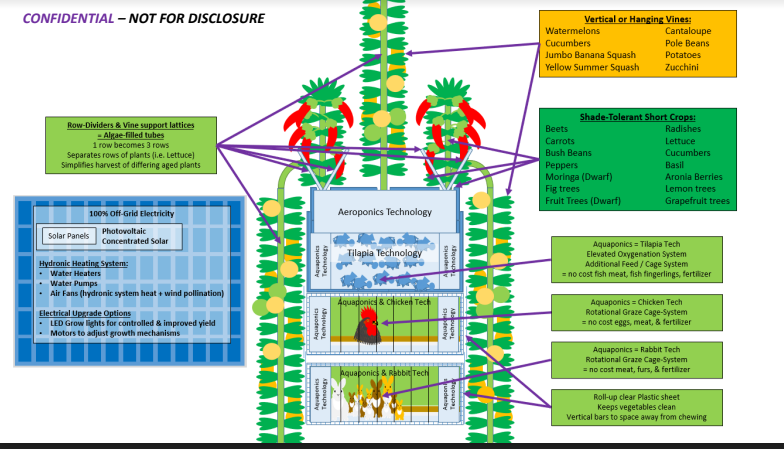
At the center of Eden’s research farm activities will be a state-of-the-art, working garden and laboratory using the most advanced growing methods in the world. It will feature a space age NASA technology known as Aeroponics.

Links